It helps to know a little about who Galileo was and what he meant for modern science. The text below also appears at the back of the book, for readers who would like some context first. It may even tempt you to read the novel. Many of the places mentioned here come to life on the page. ‘Story in pictures’.
Galileo Galilei (1564-1642)
Greater recognition for this remarkable man
Galileo: the man between heaven and earth. Anyone walking today through Padova, Pisa, or Florence as a tourist will hardly notice that one of the greatest minds in history once lived and worked there. While other great names from the past fill souvenir stalls, Galileo Galilei remains strikingly absent. A loss, because he was one of the first to dare test assumptions against observation and experiment – and in doing so laid the foundations of modern science. So before this story begins, a look at who he was and what he lived for. Only then can this book be read with the right compass.
Part I – Excitatio Cogitantis
The awakening of a thinker
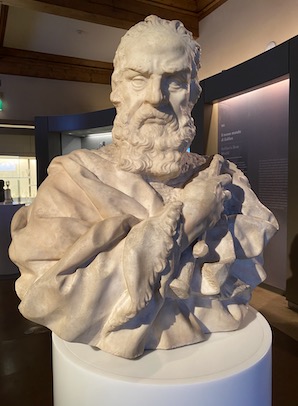
Galileo Galilei was born in February 1564 in Pisa. Not a nobleman, not a clergyman, but the son of Vincenzo Galilei, a musician. Vincenzo was more than a lute player: he composed, taught, and heard in the sounds of his instrument the mathematical proportions that sustained music. He was connected to the Camerata Fiorentina, a circle of poets and musicians who laid the foundations for what would later become opera. For him, music was not merely a gift from God. Music obeyed laws: pitch changed with the length of a string, with the tension placed upon it, with the weight that pulled at it.
In a time when authority often stood for truth, Vincenzo taught his son that obedience is not the same as understanding. Where most people heard only melody in music, he showed Galileo that order lay hidden behind harmony. For the boy it was a revelation. Later he would say that nature is written in the language of mathematics. Perhaps that language already sounded in the house of his childhood, in the vibrations of the lute that echoed there day after day.
Florence as his laboratory
A few years later the family moved to Florence. The city breathed the spirit of the Renaissance. By day painters carried their canvases to their workshops, craftsmen tested pulleys and screws in their ateliers, poets recited their verses in squares beneath the shade of loggias. Toward evening the sky turned orange behind Brunelleschi’s dome, which hung above the city like a sky of stone. For Galileo, Florence became a living laboratory.
He saw how artists used perspective to create space upon a flat surface, how engineers lifted water to gardens set high above the streets, how merchants drew up tables that resembled algebra more than bookkeeping. Everything seemed capable of improvement, calculation, investigation. The city showed that people were no longer content with the authority of old books, but looked, measured, and built for themselves. Galileo grew up amid this restless world of questions and discoveries and came to understand that the world was more than the echo of Aristotle.
The lamp in the cathedral
In 1581, as his father wished, he enrolled at the University of Pisa to study medicine. But the lectures on anatomy, the descriptions of organs and humors, left him cold. What held his attention were numbers, movements, rhythms.
During a Mass in the cathedral of Pisa something happened that would mark him for life. As incense curled upward and the singing rose through the vast space, he noticed a heavy bronze lamp swaying gently on a long chain. Most of the faithful looked upward in devotion. Galileo looked upward as an observer. He began to count – first with his breath, then with the pulse in his neck. To his surprise each swing lasted the same amount of time, whether the arc was wide or small. The lamp became a clock. His heartbeat an instrument. Here, in the middle of a cathedral, an idea revealed itself: that time could be measured through motion, and that motion possessed rhythm. As he continued counting, another thought arose for which he did not yet have words. Why did the lamp always return to the same midpoint? As if an invisible force pulled it downward again and again, no matter how high the arc began. He did not yet have a name for it, but the thought never left him. Galileo sensed it: nature obeyed laws, not tradition.
Toward mathematics
After several years he broke decisively with medicine. Against his father’s wishes he chose mathematics, studying under the Florentine mathematician Ostilio Ricci. Ricci showed him that numbers were not lifeless symbols but keys that opened doors. Calculation was not merely abstract – it could be applied to architecture, navigation, mechanics. Here Galileo found his calling. He began to ask questions that most professors ignored. How does a stone fall? What determines speed? Is motion a natural state, or must it always be caused? These were not speculative questions but ones that demanded proof – not tradition, but observation.
One afternoon he stood in the garden of their house in Florence with two stones in his hands: one heavy, one light. His younger brother Michelangelo watched impatiently. Galileo released them at the same moment. Both stones struck the ground almost together. “Do you see?” he said. “They fall together.” Michelangelo frowned. “But Aristotle says…” “Aristotle did not look,” Galileo interrupted him. “Nature does not lie. Books do.” It was a small moment, but it captured the essence of his thinking: truth must be seen for oneself.
Toward the core of his thinking
From that moment his path was clear. Not the ancient books of Aristotle or Galen would guide him, but reality itself. With inclined planes, spheres, water clocks, and formulas he would bring order to the apparent chaos of motion.
He did not begin with the stars.
Not with telescopes.
He began with falling.
With pendulums.
With time.
And with the conviction that truth does not descend from above, but rises from below – from what one dares to see, measure, and question.
Part II – Prima Inventio
The first discoveries
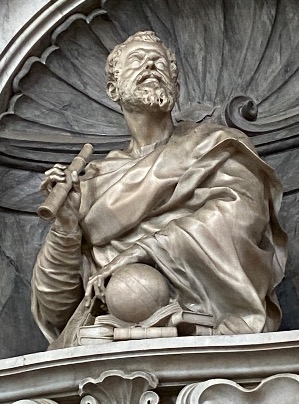
In 1589, barely twenty-five years old, Galileo Galilei was appointed professor at the University of Pisa. Not thanks to a family name or ecclesiastical favor, but through the sharpness of his mind and the boldness of his voice. He taught mathematics and natural philosophy. Where his colleagues recited the words of Aristotle as if they were sacred texts, Galileo dared to depart from them. He asked questions, challenged assumptions, demonstrated. Students were not meant only to listen, but above all to look.
The tower of Pisa
According to Aristotle a heavy object falls faster than a light one. It was written in the books, and therefore it must be true. Galileo trusted his own eyes more than books. On a cool morning he climbed the steps of the leaning tower with a group of students. In his hands he carried two spheres: one of lead, heavy and cold, the other of wood, lighter and rougher. Curious onlookers waited in the square below. When he reached the top he leaned over the edge. “What does Aristotle say?” he asked. “That the heavier falls faster, master,” a student replied. Galileo nodded and released both spheres at the same moment. They fell through the air and struck the ground almost together – a dull thud, separated by no more than a fraction of a second. The students looked at one another, confused and astonished. “You see?” Galileo said, with a smile that revealed more triumph than surprise. “Nature speaks more clearly than any book. Aristotle was wrong.” Whether this famous experiment truly took place from the tower remains debated. But the message Galileo always wished to emphasize was clear: observation outweighs tradition.
Padova – a freer world
After several years in Pisa, Galileo moved to Padova in the Republic of Venice. He would remain there from 1592 to 1610 – the most fertile years of his early career. Padova was different from Tuscany. While Florence and Pisa stood under the heavy hand of the Church, Venice breathed independence, wealth, and freedom. In its streets students from across Europe met and argued. They debated in taverns, read in dim rooms filled with manuscripts and books. Merchants brought news from the Low Countries and the Ottoman Empire. The university attracted brilliant minds unwilling to bow to dogma. Galileo found his second home here.
Inclined planes and water clocks
In his workshop he experimented with wooden channels set at angles like long ramps. He rolled spheres of different size and weight down their slopes. The longer the ramp, the slower the motion, and the more precisely time could be measured. His students helped. One held the sphere ready, another listened to the rhythm of Galileo’s pulse, a third allowed water to drip from a vessel into a bowl. The water served as a clock. The more water collected, the longer the time that had passed. Afterwards they weighed the bowl and recorded the difference.
“Master, it moves too quickly – we cannot measure it,” one of the students said nervously. “Then we lengthen the ramp,” Galileo replied calmly. “Nature does not slow down – but we can learn to look more carefully.”
The experiment was repeated. A ball rolled, the students counted, the water dripped. Galileo bent over the notes and drew a line. “You see? It is not random. The speed increases, always by the same step. Acceleration. That is what matters.” Thus he discovered that motion followed regular laws. Objects did not simply fall – they accelerated continuously, with a logic that could be expressed in numbers. Yet one question continued to trouble him. Why did everything always fall toward the earth and never the other way around? Why did stones never return upward, as if the world itself held them fast? Sometimes it seemed to him as though the earth possessed a voice that called everything gently but irresistibly toward it. He could not yet explain it, but he felt that more lay hidden beneath motion and mass alone.
Projectiles and parabolas
Falling stones were not his only fascination. Projectiles intrigued him as well. Soldiers and engineers believed that cannonballs followed a perfect, almost mystical arc, guided by a natural striving toward perfection. Aristotle had taught that motion sought its natural place.
Galileo drew lines, repeated shots, measured angles and distances. He discovered that projectiles did not follow mysterious curves but a parabola – measurable, predictable. The art of warfare, it turned out, rested not in tradition but in calculation. His knowledge made him valuable to engineers and generals and also provided income. Galileo designed compasses and measuring instruments that he sold to wealthy clients to support his family.
A method taking shape
What he accomplished in these years was more than a series of experiments. He was building a method. For the first time someone began to approach physics as one approached mathematics – systematically, step by step, with proof and repetition. His studies of pendulums led to applications in timekeeping. His descriptions of acceleration laid the groundwork for a new way of thinking about motion and force. And yet through all those years he looked mostly downward: at stones that fell, at spheres that rolled, at pendulums that marked time with their swing. The firmament remained untouched.
Part III – Caelum Aperitur
The heavens open
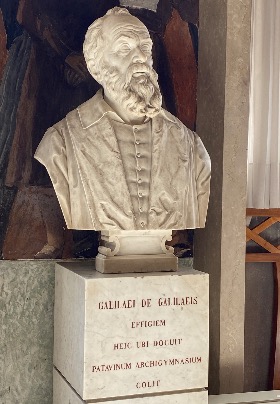
Until 1609. Then a strange rumor reached Padova: merchants spoke of a tube with lenses that brought distant objects closer. For soldiers and sailors it was a useful tool – for Galileo it was a revelation. If one could draw ships nearer, why not the heavens?
The first attempts
He shut himself away in his workshop. Glass was ground again and again, until his hands grew tired and his eyes red. Students who peered curiously through the door he dismissed curtly. The first telescopes were disappointing: the image warped, colors broke apart, lines bent away. But every failure pointed in a certain direction. After weeks an instrument stood on his table that was ten times stronger than the Dutch original. A simple tube, nothing more – but with lenses that were sharper, more precise, more carefully calculated. Galileo lifted it to his eye and aimed it upward.
The moon
It was an autumn night, clear and cool. He looked at the moon – and saw something no one had seen in quite that way before. Not a smooth, perfect heavenly body, as Aristotle and tradition had claimed. Not a crystal sphere without blemish or crack. But a world. A world with mountains and valleys, with shadows stretching across its surface like deep ravines. His breath caught. The heavens were not perfect, not untouchable. They were earthly, rough, changeable. He reached for his notebook and hurriedly sketched what he saw, as if the image might vanish if he wrote too slowly. “Montagne… mountains. Even there.”
Jupiter and its moons
A few nights later he turned his telescope toward Jupiter. Beside the planet appeared small points of light. At first he thought they were stars. But the following night they had shifted. And the night after that they moved again. They were caught in a dance: four moons circling Jupiter.
For the first time a human being saw heavenly bodies that did not revolve around the Earth. It stood in direct opposition to the ancient worldview in which everything pointed toward the center of the Earth. Galileo recorded his observations obsessively, night after night. Marks became patterns, patterns became truth.
Sometimes, after hours of observing, he continued looking a little longer. How did those moons remain so faithfully in their paths? Why did they not drift away, why did they not fall? It was as if something held them – invisible, yet powerful. He wrote nothing about it. He did not know. But the thought would not leave him. In his observations of Saturn, Galileo again chose secrecy. Through his telescope he saw something he could not interpret: the planet seemed to have ears, protrusions on either side that were sometimes visible and sometimes seemed to disappear. To conceal his confusion he wrote a first anagram:
“smaismrmilmepoetaleumibunenugttauiras”, which stood for:
“Altissimum planetam tergeminum observavi.”
“I have observed the highest planet to be triple.”
He did not yet know what he was truly seeing – the rings of Saturn would only be correctly understood decades later – but the anagram shows how even his doubt and his mystery were too great for him to share openly. He sent the anagram to Johannes Kepler, the great German astronomer who at that time was working at the court in Prague. Kepler was both a confidant and, at times, a rival. Kepler opened the letter, bent over the string of incomprehensible letters – and guessed. He believed Galileo had seen something pointing to new moons around Mars. He was wrong. Galileo smiled, but did not reveal the answer. Even for Kepler, his discoveries remained encrypted for the time being.
Venus and the sun
He turned his telescope toward Venus and saw that the planet showed phases, just like the moon – dark and bright, waxing and waning. A phenomenon that could only be explained if Venus orbited the sun, and not the Earth. Even the sun did not escape his gaze. To his astonishment he saw spots that moved, changed, disappeared. The sun was not an eternal, perfect sphere of light, but variable and imperfect. Every observation was an assault on an image that had seemed untouchable for centuries. Not intended as rebellion, but as truth.
He knew that this discovery was too dangerous to publish without caution. A second anagram that only the most perceptive minds would unravel – a whisper of insight, carefully encoded so the truth might still seep into the world:
“haec immatura a me iam frustra leguntur o.y.”, which stood for:
“Cynthiae figuras aemulatur Mater Amorum”
“Venus imitates the phases of the moon.”
Whoever rearranged the letters would discover the real message – a veiled confirmation that Venus orbited the sun, and that the Copernican system was therefore correct. Not just a theory, but proof.
Sidereus Nuncius
In 1610 he gathered his discoveries into a small book: Sidereus Nuncius – The Starry Messenger. In it he described the mountains of the moon, the moons of Jupiter, and the stars that proved to be infinitely more numerous than anyone had ever imagined. The impact was like that of a comet. At courts he was received as a marvel. Mathematicians praised him, poets celebrated him, students flocked to his lectures. But in churches and monasteries theologians frowned. What he had seen could not be true – because it was not allowed to be true.
A new heaven
The heavens were suddenly no longer the domain of angels, but of matter. Of worlds that changed, of planets that followed their own laws. Galileo had opened the gate, and there was no turning back. Yet he also knew that with every discovery the resistance would grow. What became visible through his telescope brought not only wonder, but danger.
Part IV – Exilium et Silentium
Exile and silence

Galileo Galilei had seen more than mountains on the moon or moons around Jupiter. He had come to understand the cosmos itself in a different way. His observations confirmed what Nicolaus Copernicus had dared to publish almost a century earlier in the Revolutionibus Orbium Coelestium: that the Earth was not the center of creation, but revolved around the sun. Where Copernicus had still been able to dedicate his book safely to the pope, Galileo knew that this worldview had by now become dangerous. Yet he chose to speak it aloud. He wrote, he lectured, and he defended the idea that not the Earth but the sun formed the heart of the cosmos. That was the point at which Rome intervened.
In 1633 he stood before the Inquisition in Rome. An old man, but not yet broken. His books had been declared suspect, his words turned against him. In the chamber there was no dialogue – only judgment. He was ordered to swear that the Earth did not move. On his knees he spoke the words that saved his life but destroyed his freedom.
According to legend, when he rose he whispered: E pur si muove. And yet it moves. The Inquisition was not merciful. No stake, no dungeon – but a quieter sentence: silence. He was banished from the universities, forbidden to publish, and condemned to house arrest.
Villa in Arcetri
He returned to Arcetri, in a villa on a hill outside Florence. From the windows he could see the city, and down the road the convent of San Matteo, where his daughters Arcangela and Maria Celeste lived as nuns. The days were monotonous. The garden lay quiet and neglected, the villa large but empty. A few loyal students still visited him, among them Vincenzo Viviani, who would later call himself Galileo’s “last pupil.” But most friends stayed away. Fear of Rome was stronger than friendship. His health began to crumble. His sight weakened until almost nothing remained. The man who had brought the stars closer was losing his own vision.
The letters of Maria Celeste
What gave him strength were the letters from his daughter. She wrote to him about life in the convent, about her concern for his health, about small daily matters. On evenings when his eyes failed him, Viviani read them aloud. “Beloved father,” her voice would say, “be careful with your diet. I pray that your pain may lessen. Do not forget to rest, for your mind is stronger than your body.”
Galileo smiled wryly. “My mind does not rest, Viviani. It ticks like a clock. And as long as I breathe, it keeps counting.”
Discorsi – his final work
Despite the prohibition he continued writing. No longer about the heavens, no longer about the sun or the planets, but about what no one could take from him: the Earth, falling, motion. In his villa he worked, half blind and dependent on his students, on his final and most personal book: Discorsi e Dimostrazioni Matematiche. In it he gathered everything he had investigated for decades – pendulums, inclined planes, falling bodies, projectiles.
The book could not appear in Italy. The censorship was strict, the danger real. But quietly the manuscript was smuggled north, to Leiden. There, in the printing house of Elsevier, the first copies rolled from the presses in 1638. One evening Viviani read the final passages aloud.
Galileo sat in a chair, his hands resting on his knees. “Yes,” he said softly. “Write this: ‘See how it falls. See how it moves. See how it works.’” His voice was weak, but his conviction was not.
Silence becomes printer’s ink
What Rome tried to silence found its way into the world. His words traveled – printed in the Netherlands, read in Germany, France, and England. In rooms he would never enter, young students read his proofs and tables. The voice of Galileo, forced into silence, continued to speak. Not loudly. Not triumphantly. But like a whisper on paper: the Earth moves, stones fall, everything obeys a law waiting to be discovered.
A new way of seeing
Thus Galileo lived his final years: blind but lucid, banished but not defeated. His body weak, his mind tireless. While the hills of Tuscany lay quiet outside, an old man worked within on the foundations of a new science. He had opened the heavens. Now he gave the world something else: a method. A way of seeing that could no longer disappear.
Part V – Hereditas
The legacy
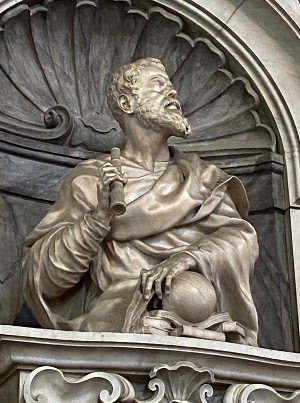
In January 1642 Galileo Galilei died. Half blind. Weakened. Exiled in his own house. There was no music. No monument was raised. Rome permitted no honor for a man who had touched heresy. His body was buried almost in silence, without splendor or ceremony, as if one hoped his memory would vanish as well. But ideas cannot be buried. They travel.
Forbidden books, living questions
His works remained on the lists of forbidden books for decades. Students who read his texts did so by candlelight, quietly, at the risk of being discovered. The prohibition only increased their attraction. Letters passed from hand to hand. Manuscripts – sometimes incomplete, sometimes wrongly copied – spread across Europe. In Prague, Paris, and London young thinkers whispered his name. Not always with admiration – sometimes still with ridicule. But no one could ignore him any longer.
The students
His last pupil, Vincenzo Viviani, tried to keep the flame alive. He wrote down memories, gathered documents, and saw himself as the guardian of Galileo’s voice. And Maria Celeste, already dead before her father, left behind letters that revealed another face: not the heretic or the hero, but the father. Vulnerable, searching, sometimes afraid – yet never silent in his heart.
Slow rehabilitation
It took almost a century before the Church partly rehabilitated him. By then he had long been in the grave. His tomb was eventually given a place in Santa Croce, among poets and artists. Too late for him. But not too late for the world he had changed.
Echoes in science
What Galileo had left behind continued to live. In the books that were printed despite the ban. In the method others adopted. In the questions he had dared to ask. His voice continued to whisper in laboratories, in lecture halls, in quiet reading rooms – whenever someone dared to look instead of blindly believe.
What remained unspoken
And yet something lingered in the air. Not everything Galileo had thought had been written down. Some words he hid in anagrams, others he withheld out of caution. Those silences still feed the imagination today. Letters, sketches, half-finished sentences suggest that there was more – that he had seen further than anyone understood. Perhaps that was his greatest legacy: not the answers, but the questions that remained.
The enduring voice.
Galileo lived in a time when looking and measuring were acts of rebellion. The silence in which he died has long since been broken. His name echoes in lecture halls, in public squares, in laboratories. He lives on in telescopes, in clocks, in every experiment that begins with the courage to doubt. And somewhere, in that space between knowing and believing, between silence and speech, a whisper can still be heard:
Look. Ask. Measure. Dare.
Home – Book reviews – Order now – About the author – About Galileo – Story in pictures